
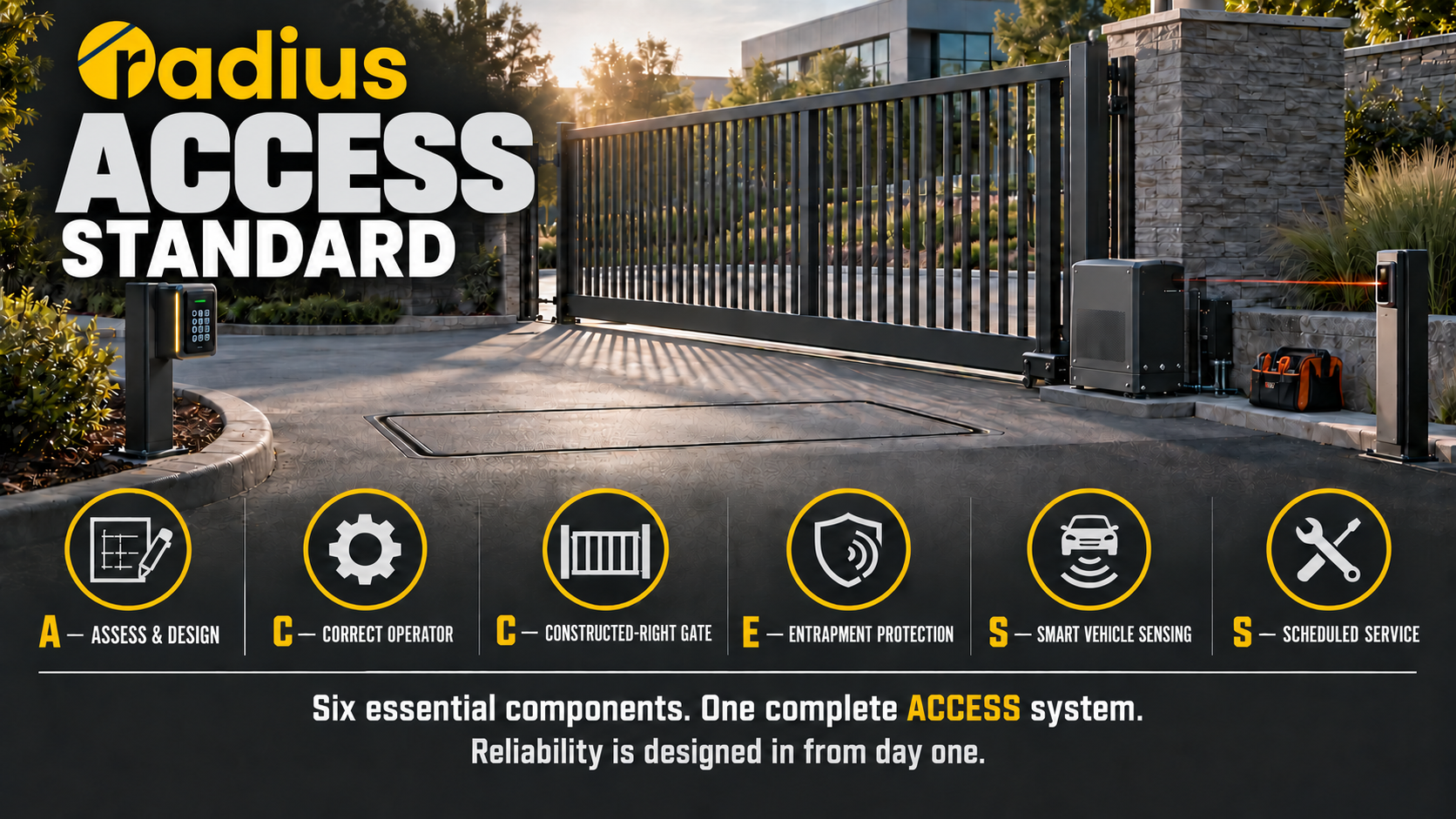
THE RADIUS ACCESS STANDARD
Six connected parts.
One complete entrance.
A gate is one component. ACCESS is the complete system.
01 / THE ACCESS STANDARD
Assess & Design
Understand the property before specifying equipment.
We begin with the opening, driveway, grade, wind, power, available space and traffic. We also discuss who will use the gate, how guests enter and how vehicles leave. The result should connect the customer’s goals to a practical site plan.
02 / THE ACCESS STANDARD
Correct Operator
Select for the real workload.
Gate weight and length are only part of the decision. RADIUS considers wind exposure, mechanical resistance, daily demand, accessory load and serviceability. Ranger HD is a residential swing preference; LiftMaster CSW24UL and CSL24UL are common choices for appropriate commercial applications.
03 / THE ACCESS STANDARD
Constructed-Right Gate
The gate must be ready to move.
Frames, posts, footers, hinges, guides and rollers must work as one structure. The gate should move freely before the operator is attached. We favor suitable hardware, including BADASS CI3000 hinges where appropriate, and a construction approach matched to the property.
04 / THE ACCESS STANDARD
Entrapment Protection
Protect every identified hazard.
A professional design evaluates opening and closing travel, posts, columns, fence interfaces, rollers and the gate’s tail. Inherent sensing and qualified external devices work together. Control placement, pedestrian access, warning signs and owner testing also matter.
05 / THE ACCESS STANDARD
Smart Vehicle Sensing
Plan arrival, waiting and exit.
Vehicle loops, probes and other detectors serve different purposes. Their selection and placement depend on the driveway and traffic pattern. Vehicle sensing supports access and operation; it must not be assumed to replace qualified entrapment-protection devices.
06 / THE ACCESS STANDARD
Scheduled Service
Keep the system in condition.
The entrance changes over time. Batteries age, connections need attention, trees grow and mechanical components wear. Follow the manufacturer’s testing instructions and establish a professional maintenance rhythm suited to the property.